
Contents
Faux leather upholstery offers the look of leather at a fraction of the cost, with easy cleaning and consistent quality — but it lacks real leather’s breathability, ages differently, and the lowest grades peel. The material is a strong choice for most sofas, chairs, and restaurant seating when you buy the right grade.
The Short Answer
Upholstery is the highest-stress application for any leather substitute: it sees constant flexing, abrasion, heat, and cleaning. Good-quality faux leather performs well in this role for 5-10 years; low-quality faux leather fails in 1-3 with cracking and peeling. That gap is why the reputation of faux leather upholstery swings so wildly — the material range is enormous. The pros are real (cost, consistency, cruelty-free, easy care), and so are the cons — polyurethane-based materials and OEKO-TEX® certified grades narrow that gap, but the raw physics of coated fabric remain. (heat retention, limited breathability, vinyl-like hand in cheap grades). Buy by grade and construction, not by label.
The Pros of Faux Leather Upholstery
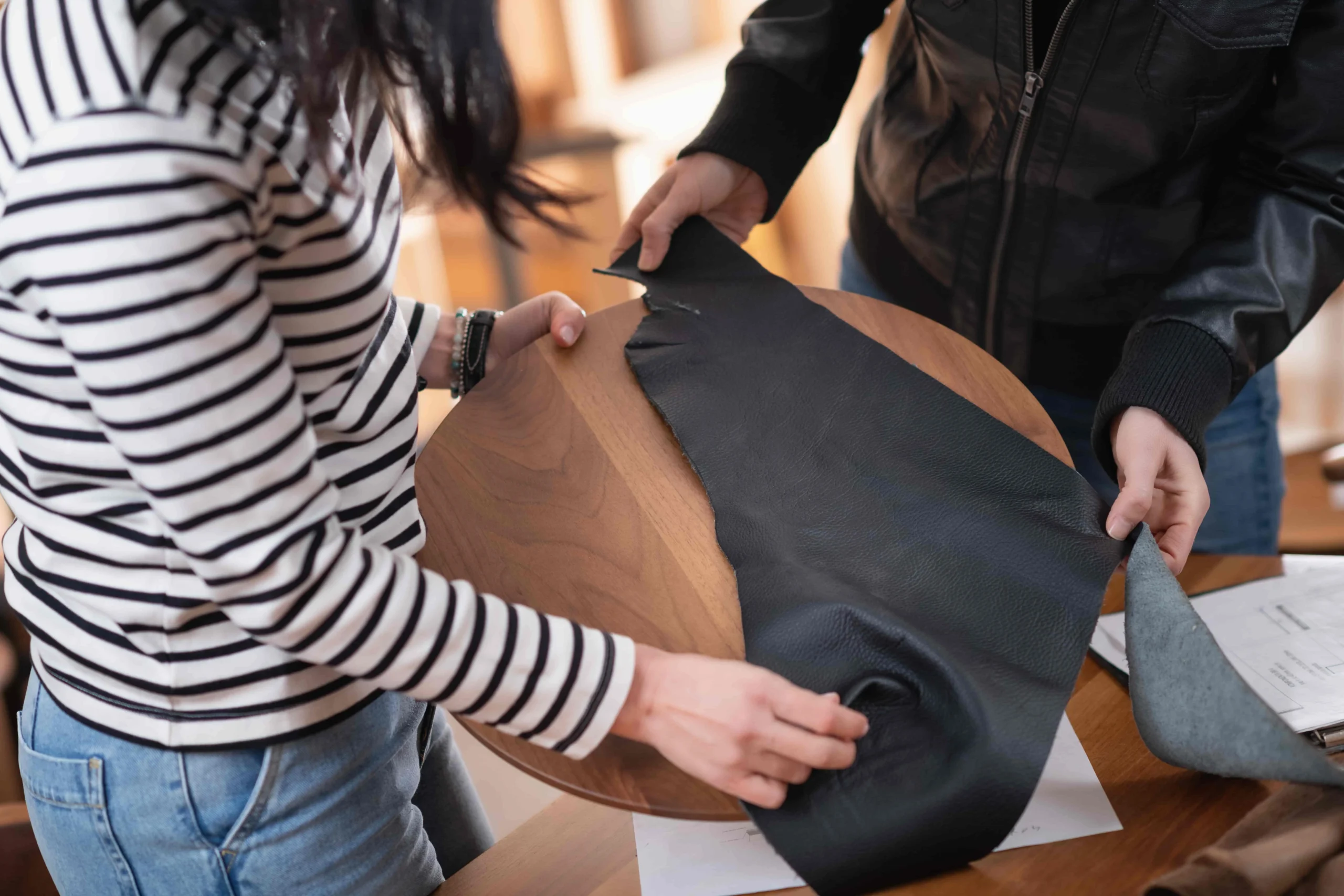
- Cost: typically 40-70% cheaper than genuine leather for comparable furniture.
- Consistency: every roll matches — no natural hide variation, no scars or blemishes.
- Easy care: most spills wipe off with a damp cloth; no conditioning required.
- Cruelty-free and vegan: no animal skin in the supply chain.
- Color and finish range: any color, emboss, or grain is reproducible at scale.
- Lightweight and easy to work: uniform backing simplifies cutting and sewing.
For furniture factories and commercial buyers, the consistency argument is decisive: natural leather requires grading and careful cutting around defects, while faux leather can be nested and cut with minimal waste. That directly improves yield and cost control.
The Cons of Faux Leather Upholstery
- Heat retention: coated surfaces trap heat and feel sticky against skin in summer.
- Limited breathability: low vapor permeability means sweat does not evaporate through the surface.
- Peeling risk: low-grade PU with thin topcoats delaminates after 1-3 years of use.
- Aging: faux leather does not develop patina; it gradually dulls or cracks instead.
- Temperature sensitivity: PVC stiffens in cold, PU can soften or degrade with sustained UV.
- Environmental footprint: most faux leathers are petroleum-based and not biodegradable.
The peeling problem deserves emphasis: peeling is a failure of coating quality, not of the faux leather concept. Topcoats that are too thin, backings that are too weak, or plasticizers that migrate will all cause delamination. Higher-spec materials — thick PU topcoats, microfiber bases, proper UV stabilizers — avoid the failure mode entirely.
Type Matters: PU vs PVC vs Microfiber
| Type | Best For | Durability | Comfort | Cost |
|---|---|---|---|---|
| PU leather | Sofas, chairs, general upholstery | Good (grade dependent) | Moderate | Low-medium |
| PVC leather | Restaurant, heavy commercial seating | Very good but stiff | Lower (stiff, warm) | Low |
| Microfiber PU | Premium seating, automotive | Excellent | High (breathable) | Medium-high |
| Silicone leather | High-end, eco-conscious projects | Very good | High | High |
When a buyer asks “is faux leather good for upholstery?”, the real question is which type. A premium microfiber or silicone leather outperforms low-grade genuine leather in many metrics; a bargain PU will disappoint. FUZHOU’s lineup covers all four so the right material can be matched to the application’s wear level.
Faux vs Real Leather at a Glance
| Factor | Faux Leather | Real Leather |
|---|---|---|
| Initial cost | Low to medium | High |
| Lifespan (upholstery) | 5-10 years (good grade) | 15-25 years with care |
| Patina / aging | No patina, dulls | Develops character |
| Breathability | Low | Moderate-high |
| Maintenance | Wipe clean | Condition, protect |
| Consistency | Perfect, repeatable | Natural variation |
Who Is Faux Leather Upholstery For?
Faux leather suits buyers who prioritize budget, consistency, easy care, and ethics over longevity and prestige. It is ideal for: first-home furniture, high-traffic commercial seating where leather would be financially wasteful, hospitality that needs every unit identical, and vegan households. It is a weaker fit for heirloom pieces, hot climates with heavy perspiration, and clients who expect leather’s patina to develop over decades.
How to Judge Quality Before Buying
- Check the backing: a dense knit or microfiber base resists tearing; thin non-wovens fail fast.
- Look at the topcoat: thick, consistent coating resists peeling; glossy “plastic” look often signals thin PVC.
- Ask for test data: abrasion (Martindale cycles), flex resistance, and tensile strength from the supplier.
- Verify compliance: OEKO-TEX® Standard 100 certification covers harmful substances for indoor upholstery.
- Test heat: sit on a sample for 10 minutes in warm conditions to judge stickiness and breathability.
FAQ
How long does faux leather upholstery last?
With good-grade PU or microfiber material, 5-10 years in normal residential use. Cheap PU or PVC can fail in 1-3 years with peeling. Sun exposure and heat accelerate degradation.
Is faux leather good for sofas?
Yes, if you buy the right grade and use it in moderate conditions. It is cheaper, easier to clean, and consistent — but it runs warm in summer and will not develop patina like real leather.
Does faux leather peel on furniture?
Low-quality faux leather peels because the topcoat is too thin or the backing too weak. Quality material with a thick PU topcoat and stable base does not peel under normal use.
Is faux leather hotter than real leather?
Generally yes. Coated faux leather has lower vapor permeability, so it traps heat and moisture against the skin. Microfiber-based faux leather breathes better than standard PU.
Is vegan leather the same as faux leather?
Mostly, but not always. Faux leather is usually synthetic (PU/PVC). “Vegan leather” can include plant-based materials (cactus, mushroom, apple) as well as synthetic ones. Both avoid animal skin.
Upholstery-Grade Faux Leather, Certified and Consistent
Sources: Wikipedia – Leather.