





Short answer
Outdoor upholstery fabric has to survive three things indoor fabric never meets: sunlight, constant moisture and heat. For faux leather, that means three specs to define: UV and color stability, mildew resistance, and hydrolysis resistance in humid heat. Vinyl (PVC) coatings are the usual starting point; PU needs a hydrolysis-resistant build. Ask for the test method and report for each spec.
Key Takeaways
- Sunlight, moisture and heat decide outdoor life. Abrasion alone does not.
- Define UV, mildew and hydrolysis requirements before you request samples.
- Exposure tests simulate weathering. They compare materials; they do not promise a service life.
- The backing, the coating and the stitching all age differently outdoors.
- This guide covers patio and RV seating on land. Boat seating has its own article.
What makes outdoor upholstery fabric different from indoor fabric?
Outdoor upholstery fabric is built to keep its color, strength and surface under sun, rain, humidity and temperature swings. Indoor fabric is built for wear and appearance, and it is rarely tested for any of those exposures.
Three stresses work together outdoors:
- Ultraviolet light: fades color and can make a coating chalky, stiff or brittle over time.
- Moisture: rain, dew and humidity soak foam and seams, and they feed mildew on the surface.
- Heat: a dark seat in direct sun gets far hotter than the air around it, which speeds up every other aging process.
The combination matters more than any single factor. Heat and humidity together are what attack many PU coatings, a failure mode described in our guide to why PU leather peels.
Which faux leather materials suit outdoor seating?
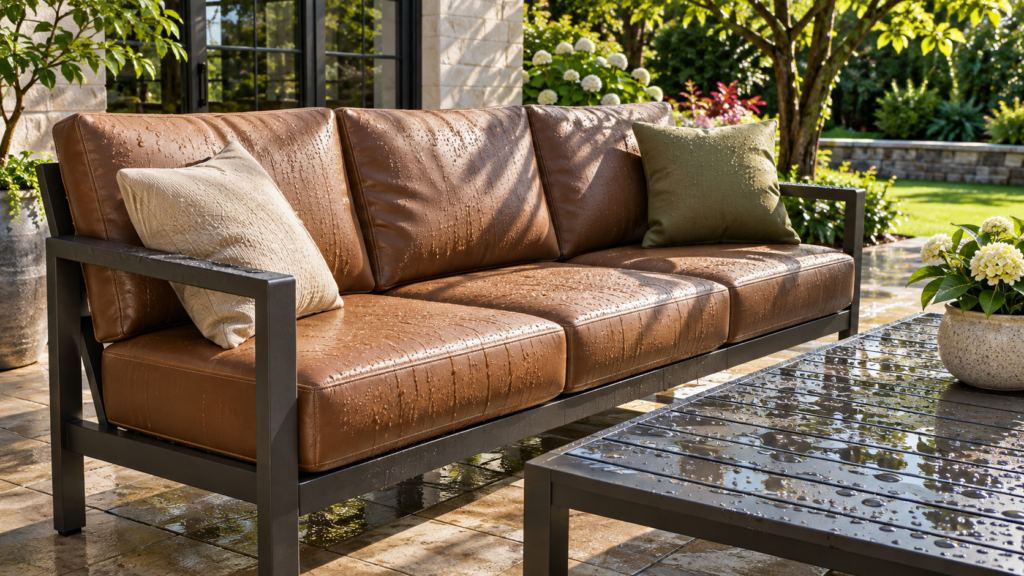
Vinyl (PVC) coated fabric is the most common faux leather for outdoor seating, because a PVC surface is waterproof and wear-resistant. PU and microfiber can work outdoors only when the construction is designed for it and the supplier can show test results.
| Material | Outdoor strengths | What to confirm |
|---|---|---|
| PVC (vinyl) leather | Waterproof, wear-resistant surface; common for outdoor and RV seating | UV and color stability, cold-crack behavior, plasticizer system |
| PU leather | Soft hand-feel, wide range of finishes | Hydrolysis resistance in humid heat; surface stability |
| Microfiber leather | Smooth and suede finishes on a microfiber base | Water absorption at cut edges and seams; UV stability |
| Woven outdoor fabrics | Breathable, dry quickly, color often runs through the yarn | A different product family, not a faux leather |
How are UV resistance and color stability specified?
UV resistance is specified by exposing the material to a defined UV and moisture cycle and then measuring the change in color and surface. The cycle comes from a standard, so two suppliers can be compared on the same basis.
Two ASTM practices are widely used for this kind of exposure:
- ASTM G154: operating fluorescent UV lamp apparatus to reproduce weathering effects of sunlight, moisture and heat.
- ASTM D4329: fluorescent UV lamp exposure of plastics, which uses the same lamp principle for plastic materials.
A lab test accelerates aging. It ranks materials against each other, and it does not convert directly into years on a patio. Treat any “lasts X years outdoors” claim as marketing unless it names the method, the exposure hours and the pass criterion.
How is mildew resistance specified?
Mildew resistance is specified by a fungal-growth test result, together with a note on what the surface needs to stay clean. A faux leather surface does not feed mold by itself; dirt, body oils and trapped moisture do.
- Surface: a smooth coated surface wipes clean and dries fast, which limits where mildew can start.
- Seams and edges: stitching holes and cut edges let water into the foam and backing, and that is where mildew often shows first.
- Foam and drainage: an open-cell foam that drains and dries helps more than any surface property.
Why does hydrolysis resistance matter for outdoor seating?
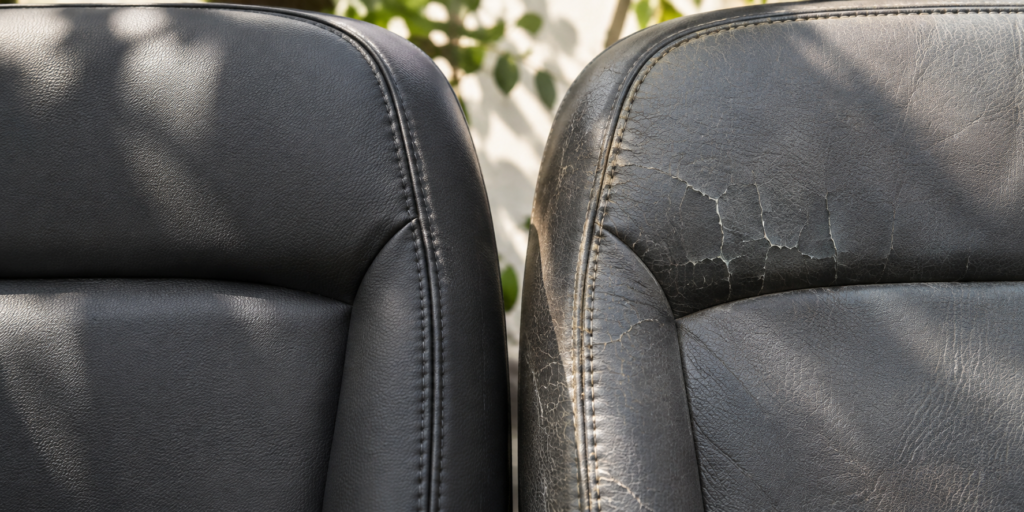
Hydrolysis resistance matters because PU can slowly break down in warm, humid conditions, and the surface then cracks or peels. Outdoor and RV seating spends years in exactly those conditions.
Hydrolysis is tested by aging samples in heat and humidity, and the result is usually reported as the time before the surface fails. Methods and pass criteria differ between customers, so write the exact method and the number of cycles or days into your specification. Our testing standards guide explains how hydrolysis, abrasion, flex and colorfastness tests differ.
What about cold weather, flex and seams?
Cold, repeated flexing and seam stress can fail an outdoor seat even when UV and mildew specs are met. Each of the three is tested separately for coated fabrics.
- Cold cracking: a coated surface can stiffen in the cold and crack when folded or sat on. ASTM D2136 is a low-temperature bend test for coated fabrics.
- Coating adhesion and seam strength: ASTM D751 covers coated fabrics and lists adhesion of the coating to the fabric, seam strength and accelerated heat aging among its test methods.
- Flex durability: repeated bending at seat edges and cushion corners is a common failure point.
What should buyers and product makers check?
Buyers should write outdoor requirements as measurable specs and ask for a report on the exact construction they will buy. A general brochure claim is not a spec.
- Exposure: sun-exposed patio, shaded porch, RV exterior storage or RV interior. Each has a different UV and heat load.
- UV and color: the test method, the exposure hours and the allowed color change.
- Mildew: the fungal-growth result and the cleaning method the supplier recommends.
- Hydrolysis: the method, the conditions and the time to failure, if the surface is PU.
- Cold and flex: a low-temperature bend result and a flex result if the seat folds or sits in freezing weather.
- Seams and backing: the thread, the foam and the backing, because a surface spec alone does not protect the whole cushion.
- Color: a physical sample, since dark colors run hotter in the sun.
The faux leather specification sheet guide lists ten specs to define before you request samples.
How does Fuzhou Leather approach outdoor seating materials?
Fuzhou Leather manufactures PU, PVC, microfiber and silicone synthetic leather in rolls, and its product pages list OEM/ODM development, sampling and bulk production. The notes below come from those pages.
- Constructions: PVC leather is described as waterproof and wear-resistant; PU leather and microfiber leather cover soft hand-feel finishes.
- Testing: finished rolls are tested for abrasion resistance, flex durability and colorfastness, and each bulk batch is checked against the approved sample.
- Customization: thickness, backing, surface and color can be adjusted to your sample, with a counter-sample for approval before bulk production.
- Order terms: MOQ is listed at 500–800 meters per color depending on the product page, so confirm the figure for your material.
If your outdoor specification includes UV, mildew or hydrolysis values, send the method and target with your inquiry so the construction can be proposed against it.
Sourcing synthetic leather for outdoor seating?
Fuzhou Leather offers OEM/ODM development, sampling and bulk production. Send your application and a reference sample for a counter-sample.
Request a quoteFrequently Asked Questions
What is the best outdoor upholstery fabric?
The best outdoor upholstery fabric is the one whose UV, mildew and hydrolysis results match your exposure. Vinyl (PVC) coated fabric is the usual faux leather choice, and woven solution-dyed outdoor fabrics are the main alternative.
Can faux leather be used outdoors?
Faux leather can be used outdoors when the construction is designed for it and the supplier can show UV, mildew and hydrolysis test results. Indoor-grade PU is not a safe assumption for sun and humidity.
Does outdoor upholstery fabric fade in the sun?
Outdoor upholstery fabric fades at different rates depending on pigment, coating and color, and dark colors also run hotter. Ask for a UV exposure result and judge color on a physical sample.
How do you stop mildew on outdoor cushions?
You limit mildew on outdoor cushions by keeping the surface clean and letting foam and seams drain and dry. A smooth coated surface wipes clean, but trapped moisture inside the cushion is the usual cause.
What tests apply to outdoor upholstery fabric?
Outdoor upholstery fabric is checked with UV exposure, mildew, hydrolysis, low-temperature bend, coating adhesion and seam strength tests. The exact methods and pass criteria are agreed between buyer and supplier.
Bottom line
Outdoor seating fails from sun, moisture and heat acting together, so specify UV, mildew and hydrolysis separately and ask for the method behind each number. Treat lab results as a way to compare materials, not as a service-life promise. For the PU versus vinyl decision, start with the construction, then confirm the reports.