





Short answer
For restaurant booth upholstery, choose a coated material that wipes clean, resists daily abrasion and has strong seams. Vinyl (PVC) is the usual high-traffic choice, PU gives a softer hand-feel, and microfiber gives a suede look but needs more careful cleaning. Specify the cleaner you will use, the seam strength and the seat structure, not only the color.
Key Takeaways
- Booth seating is cleaned many times a day, so cleaner tolerance matters as much as abrasion.
- Seams, piping and corners fail before the flat surface does.
- Vinyl, PU and microfiber trade off cleanability, hand-feel and cost differently.
- Ask which cleaners and disinfectants the supplier has approved for the exact construction.
- Define the booth structure first: bench, back, tufting and foam all affect stress.
What upholstery works best for restaurant booths?
The best restaurant booth upholstery is a coated faux leather that is easy to clean and strong at the seams. Vinyl (PVC), PU and microfiber leather are the three constructions most booth makers compare.
| Material | Strengths for booths | Watch for |
|---|---|---|
| Vinyl (PVC) leather | Waterproof, wear-resistant surface that wipes clean | Firmer hand-feel; check cleaner tolerance and cold-crack behavior |
| PU leather | Softer hand-feel, wide range of grains and finishes | Quality depends on the construction; confirm flex and abrasion results |
| Microfiber leather | Smooth or suede finish on a microfiber base | Suede finishes show marks; confirm how the surface is cleaned |
| Woven fabric | Soft, patterned, quiet | Absorbs spills; a different product family |
For the construction differences, see PU vs PVC vs microfiber leather.
Why does cleaner tolerance matter for booth upholstery?
Cleaner tolerance matters because booths are wiped and disinfected many times a day, and a cleaner that damages the coating shortens seat life. The same wiping that keeps a seat hygienic can dull, stiffen or crack a surface that is not suited to it.
Product makers should settle three points with the supplier:
- Which cleaners: the soap, sanitizer or disinfectant the restaurant will actually use.
- How they are used: dilution, contact time and whether the surface is rinsed afterward.
- What the label says: the supplier’s cleaning guidance for the exact construction, which should travel with the booth to the restaurant.
Always test the cleaner on a sample before you finalize the specification. General cleaning and care advice for synthetic leather is in our faux leather care guide.
Where do restaurant booths fail first?
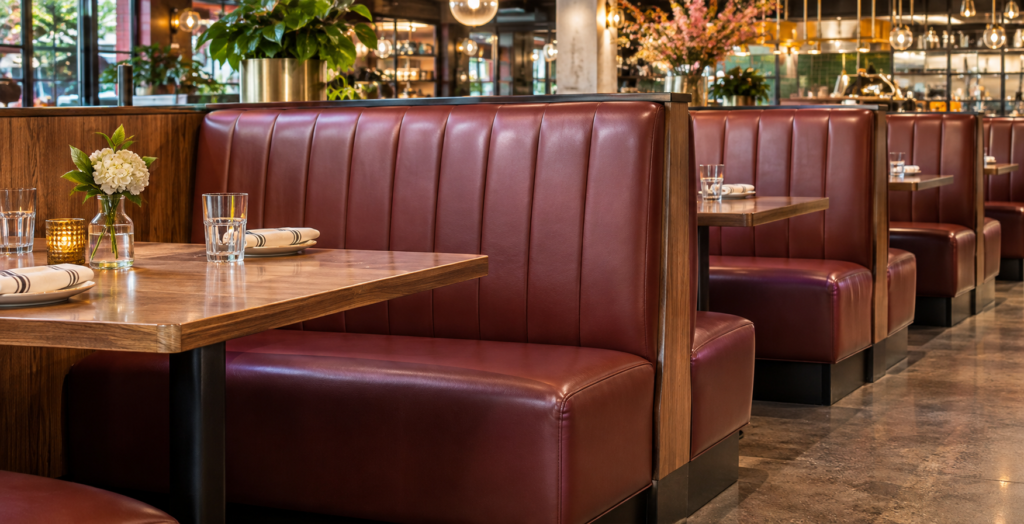
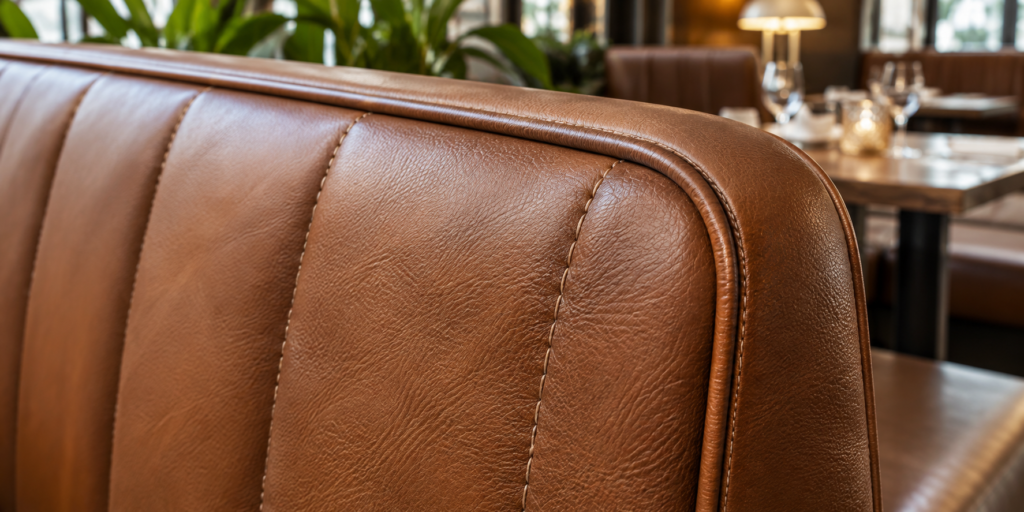
Restaurant booths usually fail first at seams, piping, corners and the front edge of the seat, not on the flat surface. Those areas take the most stress from sliding in and out.
- Seams: thread, stitch density and seam allowance matter. Coated fabric test methods include seam strength; ASTM D751 lists seam strength and adhesion of the coating to the fabric among its methods.
- Piping and tufting: tight curves and buttons concentrate stress, so a stiff or thick material can crack at the fold.
- Front edge: the seat edge takes repeated flex and rubbing, which is why flex durability is worth a separate check.
- Backing: a weak backing lets the surface tear along the stitch line.
How much abrasion resistance does a booth need?
A booth needs a commercial-grade abrasion result, reported with the method used, because seats in a busy restaurant are sat on all day. The two common methods are the oscillatory cylinder test and the Martindale test.
- Oscillatory cylinder: ASTM D4157, often called the Wyzenbeek method, reports rubs.
- Martindale: ASTM D4966 describes the Martindale abrasion tester method.
The two methods give numbers that cannot be compared directly. Our guide to Martindale vs Wyzenbeek explains how to read each one, so this article leaves the test details there.
Does the booth structure change the material choice?
The booth structure changes the material choice because bench height, back angle, foam and tufting set how much the surface stretches and flexes. A flat bench cushion and a deep tufted back are different jobs.
- Flat panels: a thicker, firmer material is fine and wipes easily.
- Tufted or curved backs: a more flexible material with a suitable backing avoids cracking at the folds.
- Foam: high-resilience foam adds flex cycles; poor drainage lets spills reach the backing.
- Heat: leather-like surfaces feel warm in summer, which is a comfort point for guests in short clothing.
How do grain, color and pattern affect wear in a booth?
Grain, color and pattern change how fast a booth looks worn, even when the material underneath is the same. A surface that hides marks stays presentable longer between cleanings.
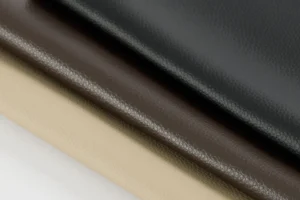
- Grain: a shallow or medium grain hides scuffs and wipes clean, while a deep grain holds dirt and needs more cleaning effort.
- Color: mid and dark tones hide marks and fading better than very light solids, but dark colors show dust and pale hair.
- Pattern and embossing: a visible pattern disguises small scratches and seams, which matters on a bench that is used all day.
- Finish: matte surfaces show fewer fingerprints than high-gloss ones; judge the finish under your restaurant’s real lighting.
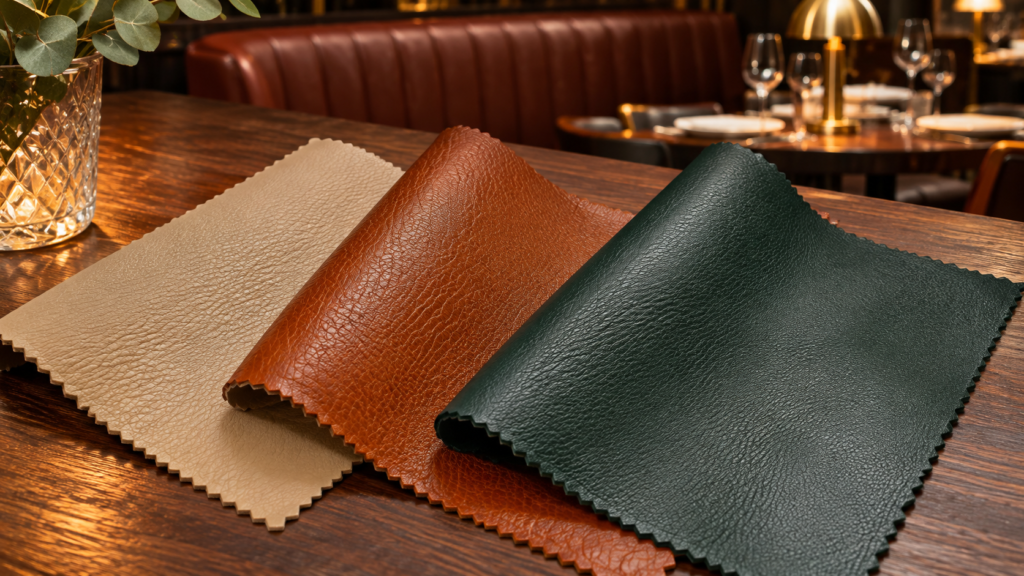
Custom embossing and color matching to a sample let a restaurant keep one look across new and reupholstered booths. Always approve the finish on a physical sample, never on a screen.
How should you think about cost per seat?
Cost per seat should be judged over the life of the booth, not by the price per meter of the roll. A cheaper material that needs reupholstering sooner costs more per year of service.
- Material price: varies with construction, thickness and finish, and it falls as quantity rises.
- Labor: cutting, sewing and fitting cost the same whichever material you choose, so a poor material wastes the same labor twice.
- Downtime: a reupholstered booth is a booth out of service during a busy period.
- Consistency: buying one lot for a whole room avoids visible color differences between seats.
Quantity planning also helps. Roll supply is quoted per color, and the order terms differ by product page, so confirm the minimum before you plan a multi-color room.
What should buyers and product makers check?
Booth makers should ask for the cleaner list, a seam test, abrasion and flex results, and a physical sample in the real color. Price per meter is only part of the cost; reupholstery is the larger one.
- Cleaning: the approved cleaners and the supplier’s written guidance.
- Abrasion: the method and the result for the exact construction.
- Flex and seams: flex durability and seam strength, since booths fail at edges.
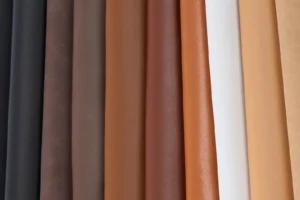
- Color and grain: a physical sample; grain hides wear, and dark colors hide marks.
- Consistency: that bulk rolls match the approved sample, because a reupholstered booth must match the others.
- Fire and local codes: requirements vary by jurisdiction, so confirm the report your local authority expects with the supplier before ordering.
How does Fuzhou Leather approach restaurant seating?
Fuzhou Leather manufactures PU, PVC and microfiber leather in rolls and supplies furniture makers; its pages list OEM/ODM development, sampling and bulk production. These points come from its own pages.
- Materials: PU leather, PVC leather and microfiber leather for upholstery, described on the sofa and furniture upholstery page.
- Testing: finished rolls are tested for abrasion resistance, flex durability and colorfastness.
- Consistency: production parameters are fixed and recorded, and each bulk batch is checked against your approved sample, so a later order matches the first.
- Customization: thickness, backing, texture and color can be matched to your sample; foam lamination is available for padded panels.
- Order terms: MOQ is listed at 500–800 meters per color depending on the product page.
Sourcing synthetic leather for booth seating?
Fuzhou Leather offers OEM/ODM development, sampling and bulk production. Send your booth sample and the cleaner you use for a counter-sample.
Request a quoteFrequently Asked Questions
What is the best upholstery for restaurant booths?
The best upholstery for restaurant booths is a wipe-clean coated material such as vinyl or PU with strong seams. Choose by cleaner tolerance, seam strength and abrasion results rather than color alone.
Is vinyl or PU better for restaurant booth upholstery?
Vinyl is better when a waterproof, wear-resistant surface is the priority, and PU is better when a softer hand-feel matters. Both need a confirmed cleaner list and seam test.
How often is restaurant booth upholstery replaced?
Restaurant booth upholstery is replaced when seams, edges or the surface fail, and the interval depends on traffic, cleaning and construction. No single lifespan applies to every booth.
Can restaurant booth upholstery be disinfected?
Restaurant booth upholstery can be disinfected only with products the supplier has approved for that exact material. Test the product on a sample and follow the label for dilution and contact time.
Why do booth seams split first?
Booth seams split first because sliding in and out concentrates stress at seams, piping and the seat edge. Seam strength and backing quality decide how long they hold.
Bottom line
Booth upholstery is chosen for cleaning and seams as much as for color. Settle the cleaner, the seam, the abrasion result and the booth structure with the supplier, and confirm that bulk rolls match the approved sample.