

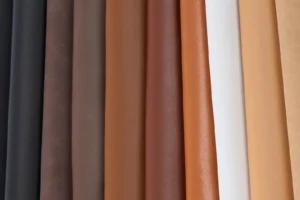


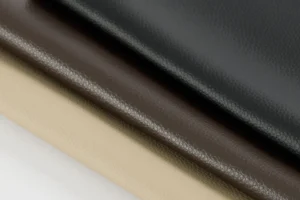


Short answer
Pet-friendly upholstery fabric is a surface that handles claws, hair, spills and daily wear with little upkeep. Faux leather is often chosen because a smooth coated surface wipes clean, does not trap hair in a weave and has no loops for claws to catch. No upholstery is claw-proof, so furniture makers should position it on cleanability and abrasion, not on scratch claims.
Key Takeaways
- “Pet-friendly” describes cleanability and wear, not damage-proofing.
- A smooth coated surface has no weave for hair, dirt or claws to catch.
- Abrasion and tear results matter more than any “pet” label.
- Liquid should stay on the surface, so seams, backing and foam need attention too.
- Avoid absolute claims such as scratch-proof; they cannot be supported.
What makes upholstery pet-friendly?
Upholstery is pet-friendly when it resists daily wear, wipes clean and does not catch hair or claws easily. These are practical properties that can be specified and tested, unlike a marketing label.
Pet households stress furniture in four ways:
- Claws: pulling, kneading and scratching damage woven loops first.
- Hair: a weave or a pile holds hair; a smooth surface releases it.
- Accidents and spills: liquids, odors and dirt need to stay on the surface and wipe off.
- Wear: jumping and lying in the same spot adds abrasion and flex.
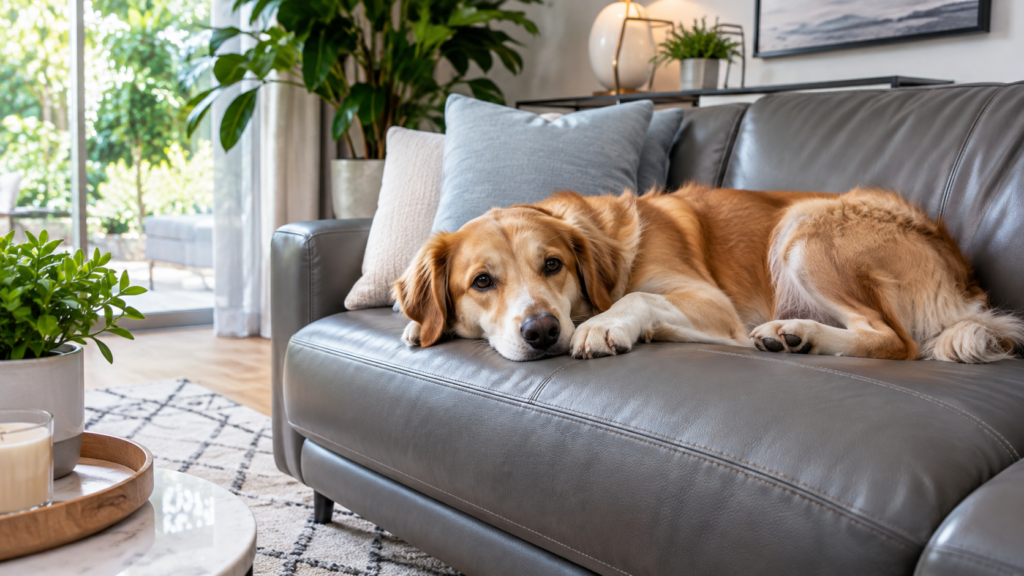
Why is synthetic leather often chosen for homes with pets?
Synthetic leather is often chosen for homes with pets because its surface is smooth, coated and easy to wipe. That removes the loops, pile and weave that hold hair and dirt in many fabrics.
| Pet concern | Why faux leather is considered | What still needs checking |
|---|---|---|
| Hair and dirt | Smooth coated surface releases hair and wipes clean | Texture depth; a deep grain holds more dirt |
| Spills and accidents | Coated surface keeps liquid on top | Seams, edges and backing, where liquid can enter |
| Claws | No woven loops to snag | Surface can still be cut or marked; no coating is claw-proof |
| Daily wear | Abrasion-tested constructions are available | Method and result for the exact construction |
General pros and cons of the material are covered in faux leather upholstery pros and cons.
Can any upholstery be called scratch-proof?
No upholstery can honestly be called scratch-proof, because a determined claw can mark or cut any surface. Furniture makers should avoid absolute claims and describe measurable properties instead.
Safer wording describes what is true and testable:
- Cleanability: “wipes clean” can be shown on a sample.
- Abrasion: a rub or cycle count with the method named.
- Tear resistance: a tear result for the construction.
- Care: instructions for cleaning and, where relevant, for repairing minor marks.
Our guides to faux leather care and repairing faux leather cover the owner side, so this article stays on specification.
Which tests matter for pet households?
Abrasion, tear and flex tests matter most for pet households, because they describe wear, cutting and repeated bending. Each is reported with a method, so results are comparable.
- Abrasion, oscillatory cylinder: ASTM D4157.
- Abrasion, Martindale: ASTM D4966.
- Tear and coating adhesion: ASTM D751 covers coated fabrics and lists pendulum, tongue and trapezoidal tear methods and adhesion of the coating to the fabric.
Abrasion numbers from different methods cannot be compared directly. Read Martindale vs Wyzenbeek before comparing two suppliers.
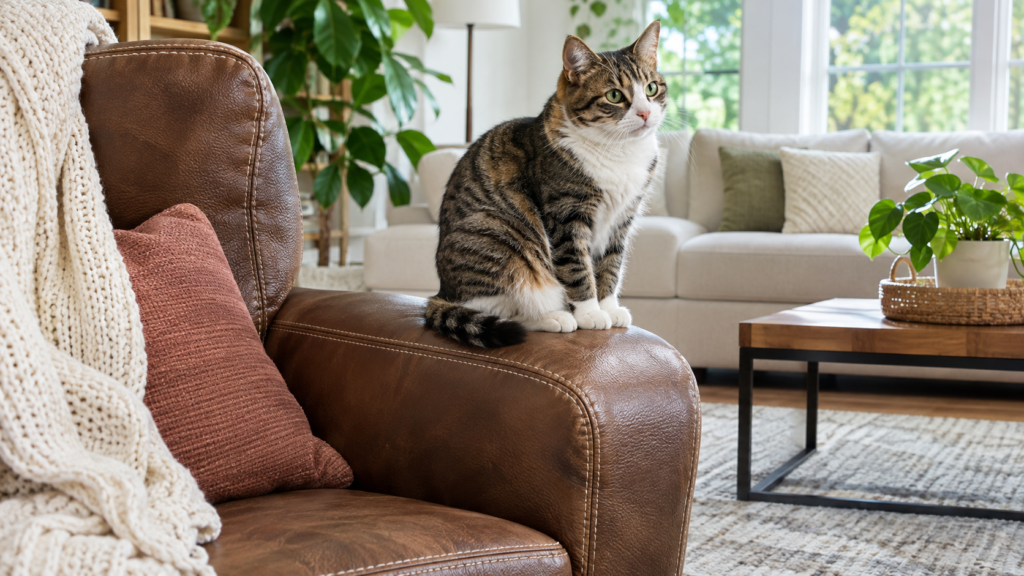
Which faux leather construction suits a pet household?
PU, microfiber and PVC leather can all suit a pet household, and the right one depends on the look and the cleaning routine. None is claw-proof; each trades hand-feel, finish and cleanability differently.
| Construction | Fit for pet households | Watch for |
|---|---|---|
| PU leather | Soft hand-feel, wide range of grains; wipes clean | Construction quality varies; confirm abrasion and flex results |
| Microfiber leather | Smooth finish for easy wiping; suede finish for a softer look | A suede finish holds hair and shows marks more than a smooth one |
| PVC (vinyl) leather | Waterproof, wear-resistant surface | Firmer hand-feel; less soft against the skin |
How do spills, odor and hair affect the choice?
Spills, odor and hair affect the choice because a pet household cleans the same sofa far more often than an ordinary one. Anything that keeps liquid and hair on the surface saves effort and protects the foam.
- Liquid barrier: a coated surface keeps liquid on top, but liquid still finds the seams, the piping and the cushion edges. A fabric with a moisture barrier or coating helps stop liquid reaching the foam.
- Odor: odor builds up in foam and backing, not on the surface, so protect the layers underneath with tight seams and easy-to-remove cushion covers.
- Hair: a smooth surface releases hair with a wipe or a lint roller, while a weave or a pile holds it.
- Static: a low-static surface attracts less hair, which is worth asking the supplier about.
Who buys pet-friendly furniture?
Pet-friendly furniture is bought by households and by operators who host pets, including rental housing and hospitality. Each group wants the same thing: seating that stays presentable with less upkeep.
- Homeowners: want a sofa that survives daily pet use and cleans quickly.
- Rental and hospitality operators: want furniture that resets between guests without a deep clean.
- Furniture brands: want a clear, honest positioning that retailers can repeat without overpromising.
For brands, the honest positioning is “easy to clean and abrasion-tested,” not “pet-proof.” That wording protects the brand if a customer’s pet does cause damage.
What should furniture makers check?
Furniture makers should check the surface, the backing, the seams and the foam, because pet damage and spills reach the whole cushion. A surface spec alone does not protect a sofa.
- Surface and texture: a smooth or shallow grain is easier to wipe than a deep one.
- Abrasion and tear: results with the method named, for the exact construction.
- Backing: a strong backing resists tearing along stitch lines.
- Seams: stitching and piping are where liquid and claws find an entry point.
- Color: a physical sample; dark colors hide dirt, light colors show it, and hair shows against color contrast.
- Consistency: that bulk rolls match the approved sample, so replacement cushions match.
How does Fuzhou Leather approach pet-household furniture?
Fuzhou Leather manufactures PU, PVC, microfiber and silicone leather in rolls for furniture makers, and its pages list OEM/ODM development, sampling and bulk production. The points below come from those pages.
- Materials: microfiber leather and PU leather for upholstery; see the sofa and furniture upholstery page for how rolls are specified by zone.
- Testing: finished rolls are tested for abrasion resistance, flex durability and colorfastness.
- Consistency: each bulk batch is checked against your approved sample, and production parameters are recorded so repeat orders follow the same specification.
- Customization: thickness, backing, texture and color can be matched to your sample.
- Order terms: MOQ is listed at 500–800 meters per color depending on the product page.
Building a pet-friendly furniture line?
Fuzhou Leather offers OEM/ODM development, sampling and bulk production. Send your reference sample for a counter-sample.
Request a quoteFrequently Asked Questions
What is the best pet-friendly upholstery fabric?
The best pet-friendly upholstery fabric is one that wipes clean, resists abrasion and has no loops for claws to catch. Faux leather with a smooth or shallow grain meets that description, and cleanability matters more than any label.
Is faux leather good for homes with pets?
Faux leather is often chosen for homes with pets because hair and spills wipe off a smooth coated surface. It can still be cut or marked by claws, so it is not claw-proof.
Can pet-friendly upholstery be called scratch-proof?
Pet-friendly upholstery should not be called scratch-proof, because no surface is claw-proof. Describe cleanability, abrasion and tear results instead.
What upholstery should pet owners avoid?
Pet owners often avoid loosely woven or looped fabrics because claws snag loops and hair clings to the weave. A smooth coated surface avoids both problems.
How do you pick a pet-friendly color?
A pet-friendly color is chosen on a physical sample, because dark colors hide dirt and light colors show it. Contrast between the fabric and the pet’s hair also decides how visible hair is.
Bottom line
Pet-friendly upholstery is about cleanability, abrasion and tear resistance, not about claims of being scratch-proof. Specify the surface, backing and seams with test results, and describe the product honestly.