





Short answer
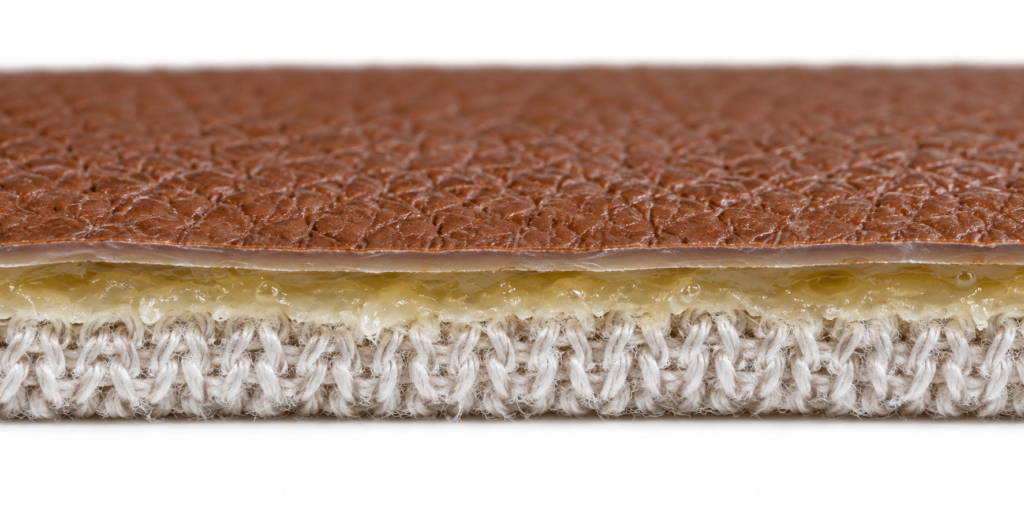
Stretch faux leather is a thin polymer coating bonded to a stretchy backing, and the backing does most of the stretching. A knit backing gives more movement, a woven backing gives more stability, and elastic fibers help the fabric recover. For garments, specify elongation, recovery and the test method together, because stretch without recovery gives baggy knees and elbows.
Key Takeaways
- The backing controls stretch. The coating only has to stay attached and crack-free.
- Stretch, recovery and permanent set are three different numbers.
- Two-way and four-way stretch describe direction, not quality.
- Thin coatings stretch easily but can crack, whiten or peel if pulled past their limit.
- Agree the test method with your supplier; do not rely on “stretchy” in a listing.
How does stretch faux leather work?
Stretch faux leather works by bonding a thin PU coating to a backing that stretches, so the whole fabric moves with the body. The coating gives the leather look, and the backing gives the elasticity.
Three layers decide the result:
- Coating: a thin, flexible PU layer that holds the grain, color and gloss.
- Adhesion: the bond between coating and backing, which has to move with both.
- Backing: a knit, a stretch-yarn woven or a similar base that provides elongation and recovery.
This is why two black faux leathers can feel identical on a hanger and behave very differently on a body. Our faux leather clothing fabric page explains how thickness, backing and finish shape drape in garments.
What is the difference between stretch, recovery and permanent set?
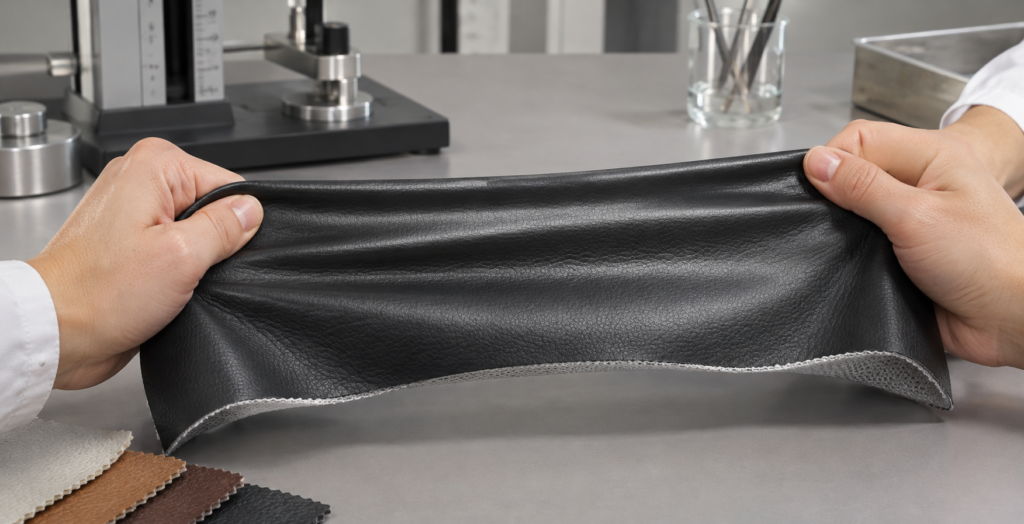
Stretch is how far the fabric extends under load, recovery is how much it returns when released, and permanent set is the part that does not return. A fabric needs all three to be acceptable for a garment.
| Term | Meaning | Why it matters in a garment |
|---|---|---|
| Elongation (stretch) | How far the fabric extends under a defined load | Fit, comfort and ease of movement |
| Recovery | How much of the extension returns after release | Keeps knees, elbows and seats from bagging |
| Permanent set | The extension that remains after release | Baggy areas and visible wrinkles |
| Cracking or whitening | The coating breaks or stress-whitens when stretched too far | Visible failure of the surface |
A fabric that stretches easily is not automatically better. Leggings need a lot of stretch and strong recovery; a jacket panel may need only a little give.
How do two-way and four-way stretch differ?
Two-way stretch extends in one direction, usually across the width, while four-way stretch extends both across and along the length. The labels describe direction, not quality.
- Two-way: stretch across the width only. Suited to panels where one direction needs give, such as sleeves or waistbands.
- Four-way: stretch in both directions. Suited to close-fitting garments that move in several directions.
- Low or minimal stretch: a small amount of give for comfort, with the shape held by the backing.
Always read the stretch figure for each direction. A listing that says only “stretchy” does not tell you whether the lengthwise direction moves at all.
How does backing type change the stretch?
Backing type changes the stretch more than any other choice, because the backing carries the elongation and the recovery. Knit backings move the most, woven backings hold shape, and non-woven or microfiber backings sit between them.
- Knit: more movement and drape, with recovery that depends on the elastic content.
- Woven: more dimensional stability; stretch only if stretch yarns are used.
- Non-woven or microfiber: a soft, even base with a different balance of strength and recovery.
- Brushed: a softer feel on the inside, chosen for comfort rather than stretch.
Test standards exist for the stretch of the backing fabrics themselves. ASTM D2594 covers stretch properties of knitted fabrics having low power, and ASTM D3107 covers fabrics woven from stretch yarns. They apply to those base fabrics, so agree separately with your supplier how the finished coated fabric will be tested.
Why does thin faux leather crack or peel when stretched?
Thin faux leather cracks or peels when it is stretched beyond what the coating and the bond can follow. The backing may recover, but the coating can whiten, crack or lift from it.
- Coating limit: a coating that stretches less than the backing breaks at the surface first.
- Adhesion: weak bonding lets the coating separate from the backing at the edges. ASTM D751 covers coated fabrics and lists adhesion of the coating to the fabric and seam strength among its methods.
- Heat and storage: elastic fibers can fatigue with repeated stretching or poor storage.
- Sewing: every needle hole is permanent in a coated fabric, so test needle and stitch length on a scrap.
For the wider picture on PU failure, see why PU leather peels.
How thin should stretch faux leather be?
Stretch faux leather for garments is usually thin so that it drapes and moves, but thinner is not automatically better. A thin material with a weak backing wrinkles, and a thick one with a strong backing can feel stiff.
- Thin and soft: best for leggings, tops and close-fitting pieces; needs a strong recovering backing.
- Medium: suits jackets and skirts that need some structure.
- Judge it in your pattern: make a sample garment, because hand feel on a table does not predict behavior on the body.
Does stretch faux leather wrinkle, sag or shrink?
Stretch faux leather can wrinkle or sag when its recovery is weak, and it should not shrink if it is made and handled correctly. Wrinkles and sagging are recovery problems; shrinkage is a heat or process problem.
- Wrinkles: appear where the fabric is stretched and does not return fully, such as knees, elbows and the seat of trousers.
- Sagging: builds up with repeated stretching when the elastic content is low or has fatigued.
- Shrinking: usually follows heat. Keep irons and dryers away from the coated surface unless the supplier says otherwise.
- Whitening: pale lines at stretched folds show that the coating is at its limit.
How does stretch relate to durability?
Stretch and durability pull against each other, because a coating that moves a lot is usually thinner and has less wear reserve. A material that stretches easily may scuff or crack sooner than a stiffer one.
Garments are judged on flex durability, abrasion and colorfastness as well as stretch. Our testing standards guide explains how those tests differ. Ask for them alongside the stretch numbers, not instead of them.
What should buyers and product makers check?
Buyers should ask for elongation in both directions, recovery after a defined hold, and the method used. A stretch claim without numbers is not a specification.
- Elongation: the figure in warp and weft, or length and width.
- Recovery: how much returns after a defined extension and hold time.
- Backing: the construction and the elastic content.
- Coating limit: the extension at which the surface cracks or whitens.
- Adhesion and seams: a coating adhesion result and a seam test.
- Sewing trial: a swatch sewn on your machine and a sample garment.
- Color and lot consistency: panels sit side by side, so a color drift between lots shows at once.
For the surrounding questions on thickness and drape, see the specification sheet guide.
How does Fuzhou Leather approach garment materials?
Fuzhou Leather manufactures PU synthetic leather in rolls, and its pages list OEM/ODM development, sampling and bulk production. These points come from its own pages.
- Customization: its manufacturing page lists thickness control, backing selection, performance adjustment, surface treatment and color matching among custom options. Whether a given stretch target can be met has to be confirmed per project.
- Testing: finished rolls are tested for abrasion resistance, flex durability and colorfastness.
- Consistency: each bulk batch is checked against your approved sample, and production parameters are recorded.
- Surface options: digital printing, embossing and hot stamping are available as secondary processes.
- Order terms: MOQ is listed at 500–800 meters per color depending on the product page.
Send the elongation, recovery and test method you need with your inquiry, along with a reference sample, so a construction can be proposed against them. The PU leather page describes the constructions.
Developing a stretch faux leather garment?
Fuzhou Leather offers OEM/ODM development, sampling and bulk production. Send your reference swatch and stretch targets for a counter-sample.
Request a quoteFrequently Asked Questions
What is stretch faux leather fabric?
Stretch faux leather fabric is a thin polymer coating bonded to a stretchy backing, so the fabric moves with the body. The backing provides the stretch and recovery.
Does faux leather stretch?
Standard faux leather stretches very little, while stretch faux leather is made with a knit or stretch-yarn backing to extend. Forcing standard faux leather to stretch can crack or whiten the coating.
What is four-way stretch faux leather?
Four-way stretch faux leather extends across the width and along the length. Read the stretch figure for each direction, because the label does not guarantee how much either direction gives.
How do you test the stretch of faux leather?
You test the stretch of faux leather by measuring elongation under a defined load and recovery after release, with the method agreed with the supplier. Standards exist for knit and stretch-yarn base fabrics, and the finished coated fabric needs its own agreed method.
Why does stretch faux leather crack?
Stretch faux leather cracks when it is pulled past what the coating and its bond can follow. Thin coatings, weak adhesion and heat all lower that limit.
Bottom line
Stretch faux leather depends on its backing for movement and on its coating and bond for survival. Specify elongation, recovery and the coating’s limit together, test a swatch on your machine, and ask the supplier to name the method behind every number.