



Short answer
Coated fabric is a textile with a continuous polymer layer on one or both sides. PU coatings are softer and more flexible, PVC coatings are heavier and tougher, and TPU coatings are a thermoplastic polyurethane option used in technical fabrics. The right choice depends on the product, the climate and the rules of your target market. Ask each supplier for datasheets, not general claims.
Key Takeaways
- A coated fabric has at least two layers: a textile and a continuous polymer coating.
- PVC came first; PU was introduced later and feels more like leather.
- One supplier’s comparison rates PU as flexible and lighter and PVC as stiffer, heavier and more durable.
- TPU coatings come in water-based and solvent-based forms; data on them in the sources we checked is limited.
- Fuzhou Leather lists PU and PVC products, not TPU.
What is coated fabric?
Coated fabric is a textile base covered by a continuous layer of polymer. A technical overview from Testex describes a coated textile as at least two layers, one being a textile and the other a continuous polymer coating, and notes that coatings can be applied as gas, liquid or solid depending on the base.
The parts you will see in a datasheet:
- Substrate: a woven, knit or nonwoven textile that gives strength and stretch.
- Coating or film: the polymer layer, such as PU or PVC, that gives the surface.
- Topcoat or finish: an optional outer layer that sets feel, gloss and stain resistance.
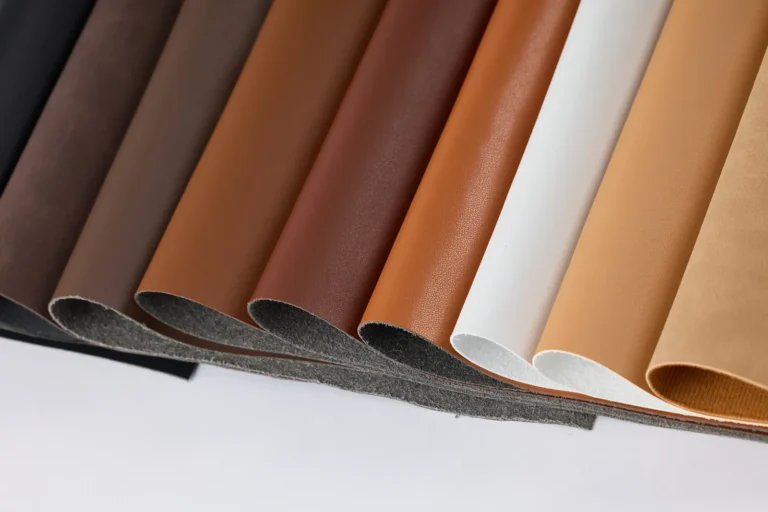
Synthetic leather is one family of coated fabric, with a leather-look surface. Our guide to faux leather types covers that family.
What is the difference between PU, PVC and TPU coatings?
PU, PVC and TPU are three polymer families used for the coating layer. They differ in feel, weight and how they are processed.
- PVC (polyvinyl chloride): Testex says PVC-coated products were used for rain-proof tarpaulins and sandals in the 20th century and by the early 1950s served as a substitute for natural leather. It also says PVC’s main weakness was poor cold and heat resistance.
- PU (polyurethane): Testex says PU coatings arrived in the late 1960s to address PVC’s weaknesses and look and feel more like natural leather.
- TPU (thermoplastic polyurethane): Tex Tech Industries says TPU coated fabrics can be formulated as water-based or solvent-based coatings.
The sources are supplier and trade pages, so treat these as general descriptions, not test results.

How do PU and PVC coated fabrics compare?
PU is lighter and more flexible, while PVC is heavier and tougher. A comparison chart from fabric supplier Canvas Etc, written for coated denier fabrics, rates the two this way:
| Property | PU coating | PVC coating |
|---|---|---|
| Flexibility and feel | Flexible, softer feel | Stiff, limited drape |
| Added weight | Moderate | Heavy |
| Breathability | Fair to good | Essentially none |
| Durability | Good | Excellent |
| Environmental notes | Hydrolysis and solvent (VOC) emissions | Chlorine content, plasticizers, disposal |
The chart refers to coated denier textiles, not leather-look fabrics, and gives illustrative ratings. Use it for the direction of the differences, not as a specification, and ask each supplier for numbers on your exact fabric.
How do the environmental differences affect the choice?
Each coating has its own environmental issues, and the main change is a shift from PVC to PU. A 2025 review by Shi, Kwok and Ngai in Collagen and Leather says PU has largely replaced PVC as the surface layer in synthetic leather, and presents waterborne PU and solvent-free PU as the main eco-friendlier options.
- Waterborne PU: uses water as the carrier instead of organic solvent.
- Solvent-free PU: is applied without a solvent carrier.
- Plasticizers in PVC: are a reason some buyers set restricted-substance lists, which you should confirm per market.
The same review says breathability of a PU coating depends mainly on its hydrophilicity and porosity. For restricted substances, see our guide to vegan leather compliance.
Which coated fabric suits which product?
Match the coating to how the product is used. These are general directions to discuss with a supplier, not guarantees.
- Soft, leather-look surfaces: PU is usually chosen where hand feel and flexibility matter.
- Heavy-duty, wipe-clean surfaces: PVC is usually chosen where toughness and low cost matter more than softness.
- TPU options: the sources we checked give limited TPU data, so ask for datasheets before specifying it.
- Mixed constructions: a PVC base with a thinner PU surface is used to balance cost and feel.
For furniture, bags and garments, compare against the product tests you need. Our PU vs PVC vs microfiber guide shows how to specify.
What should buyers and product makers check?
Check the structure, the coating chemistry and the tests before you approve a coated fabric. Six items cover most disputes:
- Layer structure: base fabric type, coating, topcoat and total thickness, written on the datasheet.
- Coating type: PU (solvent-based, water-based or solvent-free), PVC, TPU or a mix.
- Tests that match use: abrasion, flex, hydrolysis and color fastness. See our testing standards guide.
- Restricted substances: ask for test reports on the lists your market uses, for the exact batch.
- Cold and heat behavior: check cold-crack and heat aging if the product is used outdoors.
- Cost and MOQ: compare the minimum per color and the unit price at your volume.
How does Fuzhou Leather approach this?
Fuzhou Leather (Dongguan Fuzhou Leather Co., Ltd.) is a PU and PVC synthetic leather and coated fabric manufacturer with OEM/ODM and custom development. Its site lists these coated material lines:
- PU families: solvent-based, water-based and solvent-free PU.
- Semi-PU: a PVC-resin base with a thinner PU surface layer, described on its semi-PU page for bags and rainwear.
- Others: microfiber synthetic leather and silicone leather.
The site does not list TPU products, so TPU appears here only for comparison. See the PU leather page for the main range. Confirm specifications, MOQ and test reports per product.
Choosing a coating for your product?
Share your product, use conditions and target market, and Fuzhou Leather can discuss PU or PVC options, sampling and production.
Request a quoteFrequently Asked Questions
What is coated fabric?
Coated fabric is a textile base covered with a continuous polymer layer, such as PU or PVC. It has at least two layers: the textile and the coating.
What is PU coated fabric?
PU coated fabric is a textile with a polyurethane coating, usually chosen for a softer, more flexible surface. PU coatings arrived after PVC and look and feel more like natural leather.
What is PVC coated fabric?
PVC coated fabric is a textile with a polyvinyl chloride coating, usually heavier and stiffer than PU. One supplier rates PVC as more durable and essentially non-breathable.
What is TPU coated fabric?
TPU coated fabric is a textile coated with thermoplastic polyurethane, available in water-based and solvent-based formulations. Ask suppliers for datasheets, because the sources we checked give limited TPU data.
Is PU coating better than PVC coating?
PU coating is not simply better than PVC coating; it is softer and lighter, while PVC is tougher. The better choice depends on the product, the climate and your market’s rules.
Bottom line
Coated fabric is a textile plus a polymer layer, and PU, PVC and TPU give different feel, weight and processing. Define the structure, ask for datasheets and tests that match the product, and confirm restricted-substance reports for the exact batch.