Whether you are buying a sofa, car seat covers, a jacket, or upholstery materials — knowing whether you are getting real leather or high-quality faux leather is essential for making informed purchasing decisions.
This guide covers all the reliable methods to distinguish genuine leather from faux leather.
Why Identification Matters
Real leather and quality faux leather can look remarkably similar. Manufacturers increasingly produce premium faux leather that mimics genuine leather so closely that even experienced buyers can be fooled. Understanding the differences protects you from paying leather prices for faux leather — and from dismissing quality faux leather as “cheap plastic.”
Testing standards from SATRA Technology Centre and OEKO-TEX provide scientific methods for verifying material composition.
Look — Visual Inspection
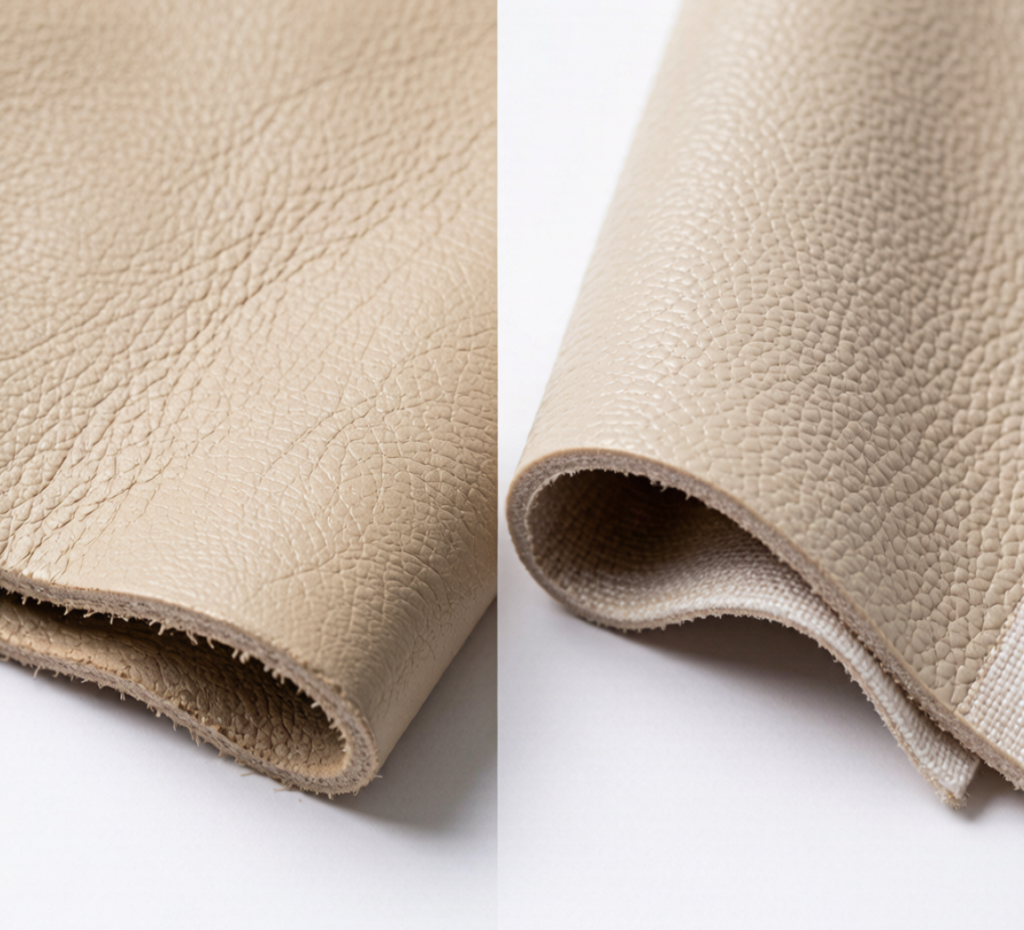
Most visible difference: Real leather has natural grain variation — no two areas look exactly the same. You will see subtle differences in texture, pores, and surface pattern. Faux leather has a perfectly uniform, repeating pattern. Look closely for identical “pores” or grain patterns repeating across the surface.
Real leather also develops a patina over time — the surface becomes richer, softer, and more characterful with age. Faux leather does not develop a patina; it either stays the same or degrades (cracking, peeling).
Feel — Touch & Texture
Real leather is warm to the touch, supple, and has a slight nap or softness. It feels organic and responsive. Faux leather feels cooler initially (synthetic materials conduct heat differently), has a more plastic-like texture, and often has a sticky or “tacky” feel in warm conditions.
Smell — The Olfactory Test
Real leather has a distinctive, complex natural odor from the tanning process. It is warm, earthy, and slightly sweet. Faux leather smells like chemicals, plastic, or vinyl. However, some faux leathers are scented to mimic leather, so combine this test with other methods.
Water Test
Place a drop of water on an inconspicuous area. Real leather is porous — the water will absorb within 30-60 seconds, leaving a dark spot that fades as the leather dries. Faux leather is non-porous — water beads up on the surface and does not absorb. This is one of the most reliable quick tests.
Burn Test
Safety note: The burn test should only be performed on a scrap piece or hidden edge. Real leather burns with a steady flame, smells like burning hair (protein-based), and leaves brittle ash. Faux leather melts and shrinks, smells like burning plastic, and leaves a hard bead. Never perform this test on a finished product surface.
Edge & Backing Inspection
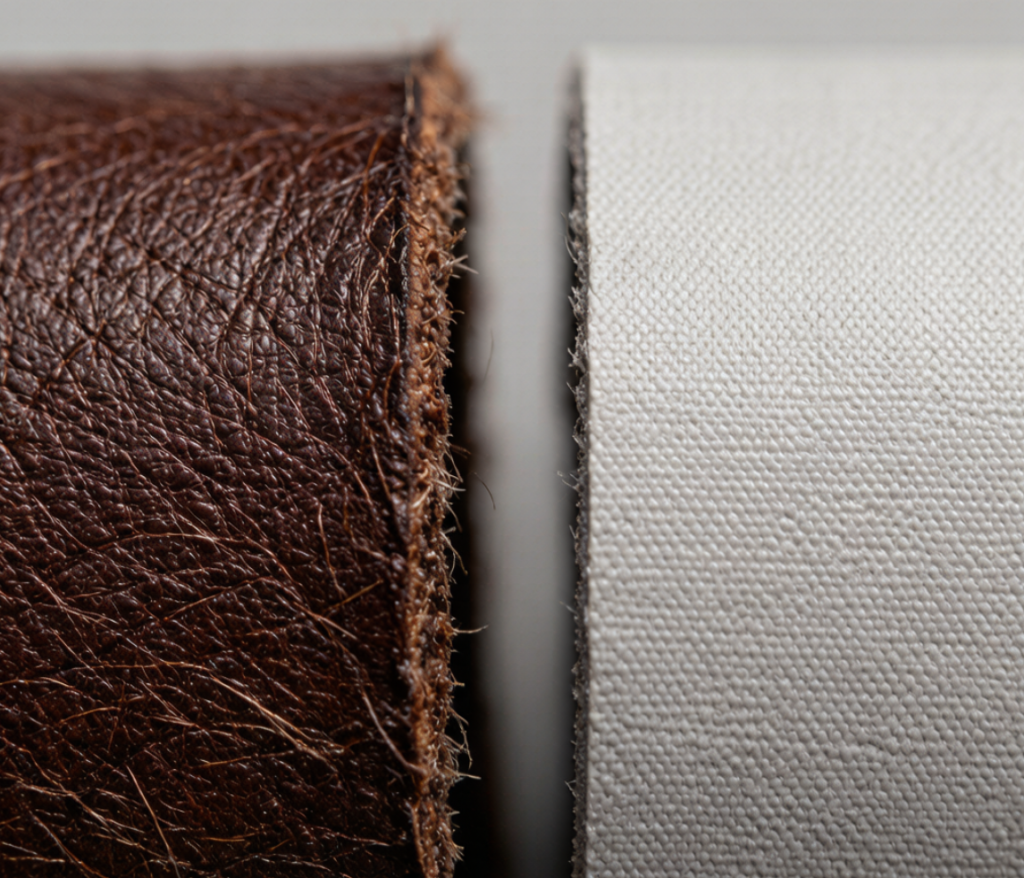
Look at a cut edge or the underside. Real leather has a fibrous, suede-like edge — you can see the hide’s natural fiber structure. Faux leather has a clean, finished edge with a visible fabric backing (woven, knit, or non-woven). Flaking at the edge reveals the fabric-polymer construction of faux leather.
Flex & Stretch Test
Fold or bend the material. Real leather creases naturally with fine wrinkles that disappear when released. Faux leather either does not crease (too rigid) or creases with larger, less natural folds. Slight stretching: real leather stretches gently and returns; faux leather either does not stretch or stays stretched.
Price as an Indicator
| Material | Typical Price per Sq Ft | Notes |
|---|---|---|
| Authentic full-grain leather | $4-12 | Premium quality, natural markings |
| Top-grain leather | $3-8 | Sanded, more uniform |
| Genuine leather (lower grade) | $2-5 | Split leather, corrected grain |
| Premium faux leather (PU) | $1-4 | High quality synthetic |
| Standard faux leather (PU/PVC) | $0.50-2 | Basic quality synthetic |
| Bonded leather | $1-3 | Contains some leather fibers |
Quick Reference Comparison Chart
| Test Method | Real Leather | Faux Leather |
|---|---|---|
| Surface grain | Natural variation, irregular pores | Uniform repeating pattern |
| Touch | Warm, supple, natural | Cool, plastic-like, tacky when warm |
| Smell | Earthy, natural leather scent | Chemical, plastic, or scented |
| Water absorption | Absorbs within 30-60 seconds | Beads up, does not absorb |
| Burn test (scrap) | Burns like hair, ash residue | Melts like plastic, hard bead |
| Cut edge | Fibrous, ragged, natural | Clean edge, fabric backing visible |
| Aging | Develops patina, improves with age | No patina, may crack/peel |
Quality Faux Leather from Fuzhou
Whether you need premium faux leather or help distinguishing materials for your project, Fuzhou Leather offers expert guidance and quality products. Our PU, PVC, and silicone leather materials are manufactured to strict quality standards, with consistent thickness, color, and texture across every batch. We serve furniture manufacturers, automotive suppliers, and material specifiers worldwide.Explore Fuzhou Leather Products → | Request Samples or Consultation
FAQ
How to tell real vs faux leather?
Use a combination of look (grain variation), feel (warmth), smell, water test (absorption), and edge inspection (fibrous vs fabric backing).
Does real leather smell different?
Yes — natural earthy, warm smell vs faux leather’s chemical or plastic odor.
Does real leather absorb water?
Yes — a drop absorbs within 30-60 seconds. Faux leather beads water.
What is the burn test?
Real leather burns like hair (protein). Faux leather melts like plastic. Use on scrap only.
Can you identify by edges?
Yes — real leather edges are fibrous. Faux leather edges show fabric backing.
Conclusion
Identifying real leather versus faux leather is a skill that combines multiple senses and tests. No single method is 100% foolproof — the most reliable approach combines visual, tactile, olfactory, and physical testing. For manufacturers and buyers sourcing materials, knowing these identification techniques ensures you get exactly what you are paying for.